I recently made a trip to Springfield, Missouri, to sit down and speak with Zach and Dylan Beck of Heidi Klum’s Bangs, following the release of their latest album Evvy on 17 May 2019. Here’s what they had to say about the album, its backstory, how it came to be made, and what the future of the band looks like.
Rex Talyetiwhoop: It’s nice to be back here in Springfield and to be meeting up with you guys again. I think the last time I was here was a couple years ago to see you guys play a show.
Dylan Beck: Back in the glory days. Good to be with you, man.
Zach Beck: Yeah, I think I remember that. That was probably, what, like Fall 2016 or something? I’m pretty sure it was a show we played at Missouri State.
RT: That sounds right. But I’m here to talk to you guys today about this new album, which is called Evvy and which you released a couple weeks ago. I have to say that I was really excited when I saw the announcement that you guys were preparing to release another album. I know you know this already, but for those who don’t, your last album A Place We Know is one of my all-time favorites. I wrote the review of it for Entertainment Weekly when they named it their Album of the Year back in 2015. It’s just a stunning record. And this new one . . . well, it’s definitely a gem, too, but it’s quite a different type of album from what A Place We Know is. Tell me a little about the record, generally, and the process in terms of how it came about.
ZB: Well, I started writing this album a while back, really. I was still living in Arkansas at the time, and so most of the songs on the album have their roots in the initial writing that I did back then. Just about every song has been somewhat changed and transformed in the period between when it was written and when it was finally recorded in the form we hear it on the album now — and some of the songs . . . “Beautiful and Bruised” and “Evvy, I Love You So Much”, for instance . . . were more or less completely reworked. But the basic framework for the album and most of its songs date back a while at this point. I think Evvy is the result of the natural trajectory of the stuff we’ve been doing for the last few years. I mean, I think of our stuff as falling into different “eras,” and Evvy is, I think, the pinnacle of our evolution, to use less than entirely precise language.
DB: Like with our last few EPs, we recorded and mixed Evvy almost entirely away from each other. We’re both in graduate school. I moved to Lawrence in August 2016, so it was a much different endeavor to write this one than A Place We Know, which we composed, recorded, and mixed together. For me, the distance really informs the sound: there are lots of melodies, instruments, and textures on Evvy. We both independently formulated ideas and pushed each track in many different directions at once.
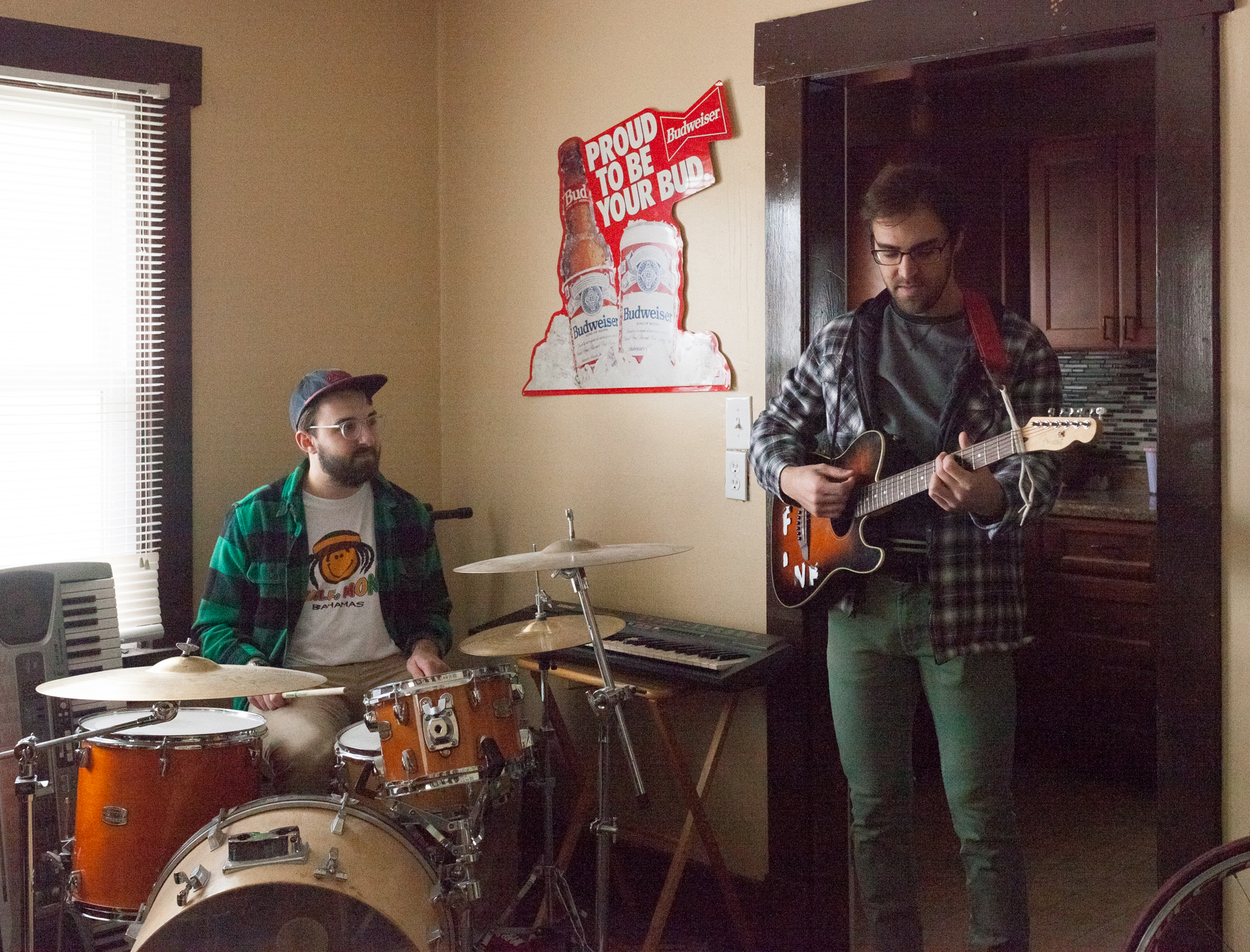
RT: I notice a lot of familiar tones and sounds on the record, but as you mentioned, there are also several new instruments in your lineup. Can you say a bit about how you came to integrate those new voices?
DB: We first used the electric bass guitar in our music on “Close My Eyes” from Coming to Soon, Pt. II, and it’s featured on six of the eleven tracks here. Come to think of it, I’m not sure how or why I decided on that texture, but I think it adds significantly to our “indie rock cred,” as we sometimes put it. (laughs) But in all seriousness, we’ve always considered our music as indie rock / psychedelic folk, and I think that’s true more than ever on this record. Back in August 2017, I purchased a Fender Duo-Sonic, and I just got good enough to feature it prominently in our music, so there’s a lot of guitar noodling here. We also somehow stumbled upon an old Wurlitzer Funmaker organ that was en route to be thrown away, and our brother-in-law helped us move it to our mom’s house. I’m really psyched we found a way to feature it on the album because it has a really beautiful, warm, and slightly eerie sound that worked perfectly for us. On the more familiar side of things, we’re still featuring the orchestral bells, horns, and our sister’s piano that she and the dogs generously allow us to record in her living room.
ZB: I think it’s always been characteristic of our stuff to incorporate a number of different sounds and textures. I mean, even as far back as Palace Pier, which came out in 2011, there’s a wide range of sonic stuff happening, and that’s something that I think we’ve always loved, using various textures to achieve certain feelings and, um, what — aural sensations, maybe? (laughs) But then, as both you and Dylan have pointed out, the expansion of our sonic palette has been something that’s been important to us, too, but in a way that’s still Heidi Klum’s Bangs, y’know? And I would say that Dylan’s done the most work and been the most effective in terms of that. This album wouldn’t sound anything like as good as it does, were it not for him — none of our stuff would. So major props to him for that.
DB: (laughs) Ever on the come-up with the engineering, mixing, and mastering.
RT: I think one of the questions that everyone who listens to this album is probably most interested in is “who (or what) is Evvy? What does Evvy mean?”
ZB: Uh, that’s . . . (laughs) that’s a really good question. It’s super hard for me to say — not that I’m saying it’s really my place to say in the first place. But it’s just . . . I kinda know internally and, like, on an internal emotional level who and what Evvy is and what everything associated with Evvy means to me. But it’d be bordering on impossible for me to try to explain or communicate any of that to anyone else in any sort of comprehensible manner.
RT: I could certainly imagine that.
DB: Well, I’m more of an outsider than Zach in that sense, so perhaps I can comment. For me, Evvy is something of a conglomeration of all of the past versions of myself. Particularly on the tracks “Every Echo Torn Asunder,” “Beautiful and Bruised,” “Evvy, I Love You So Much,” and “Evvy, If I Could Tell You,” the lyrics on this record speak to loss, loneliness, and emotional abuse, but it’s all communicated through a place of deep compassion and a desire to alleviate all of those bad things. For me, the words on Evvy speak to the anxiety and psychological pain I suffered in the past from a place of greater maturity, understanding, and peace. Evvy is about reconciliation and healing.

RT: Is there any particular backstory to the album? I realize that a question like that probably gets us back into the territory of asking who / what Evvy is, but there seem to be some pretty specific allusions to . . . well, something . . . at specific points throughout the album — “Temple City, 1970” and “Golden West Avenue”, for instance, come readily to mind. And there are lots of familial addresses, too — statements addressed to or concerning a mother and father and brother and sister — that I think most listeners will have noticed. What’s all that about?
ZB: A lot of the story / framework on which this album is based / in which it kinda comes to a more complete fulfillment — in my mind, at least — is related to this girl who came to be known as Genie. She was born in 1957 in California, and she became — well, not famous, but I guess came to national attention in 1970 when she was “discovered” after being kept in severe and terrible isolation by her father for the first 13 years of her life, and she hadn’t learned to talk and had all of these other problems. And the more I read about and researched into her story and the absolutely horrendous and appalling things that happened in her life, the more I became . . . I don’t know how to put it, and I won’t go into a whole lot of detail here because that’s again probably unnecessary, but the more I read about Genie and her family and her / its story, the more I came to identify with her and other members of her family in a variety of ways. I don’t want this to sound melodramatic because obviously her story is impossibly more tragic than anything I’ve ever experienced, but I came to feel a strange yet undeniably real affinity with Genie and to think of certain members of her family in connection with . . . other personal things and feelings. Not in any sort of rigidly literal sense, of course, but mostly metaphorically and symbolically and in other ways that I can’t explain very well, if at all. Point being, the result is this album, which involves a number of different perspectives and narrators and people singing to different people and me singing to Genie and Genie to me and God to me and me to God and Genie’s older siblings who died as infants to me and me to them and all stuff like that.
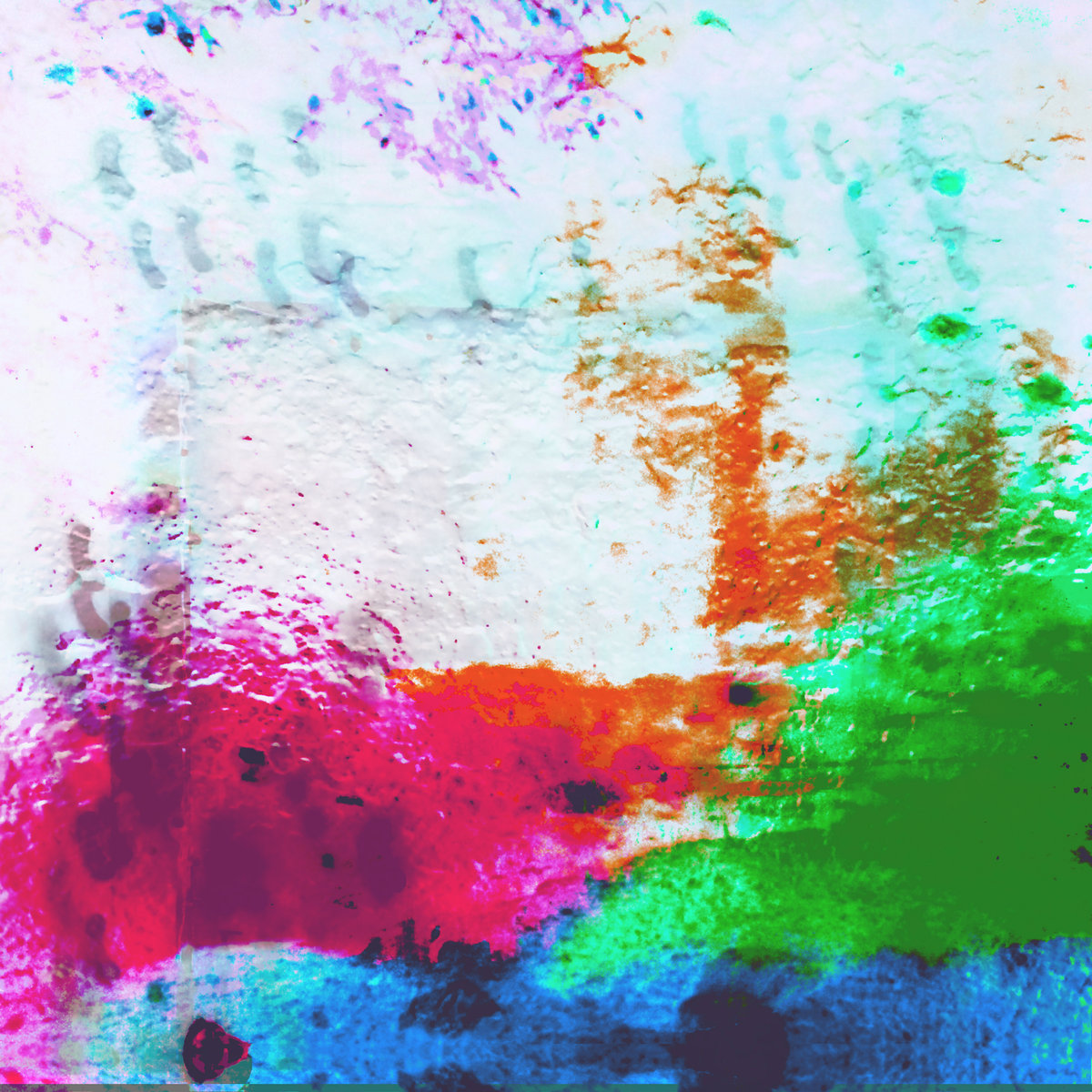
RT: Another thing that pops out when listening to the record is that there are a lot more vocal samples and weird production on this project than on anything you have done in the past. Does that have anything to do with the Evvy / Genie connection?
DB: Kind of, yes. Of course, it’s impossible for me to know what it would be like to live for 13 years without any form of language — luckily — but I imagine that Genie suffered immeasurable anxiety as a child. We tried to capture that devastation and panic throughout the record, but the moment that stands out to me as the most concentrated and distilled essence of that terror is the segment of crushing white noise before the second movement on the opening track. For me, that’s what I imagine it felt like.
RT: Oh, wow.
DB: (nods) Absolutely. I get goosebumps every time. Elsewhere, we attempted to mimic what it might have sounded like to hear Genie communicate. On “Glass Hallways,” for instance, I sampled Zach’s original vocal demo, pitch-shifted it, and looped it to create that weird chipmunk vocal and the low moaning vocal toward the end. We wanted “All You’ve Ever Known” to have this mystical, swirling texture, so I recorded and manipulated a lot of different vocal takes for that one: there’s “shh”ing, laughing, humming, and “lala”ing, to name a few. One of my favorite production touches on the record is at the end of “A Light Toward God” when the entire record can be heard playing at 64x speed. We borrowed that idea from Phil Elverum of the Microphones: many of the tracks on The Glow, Pt. 2 can be heard in bits and pieces on its closer.
ZB: Yeah, all of that was Dylan’s doing. I almost cried the first time I heard the end of “Glass Hallways” with the chipmunk-vocal-thing that Dylan just described. It was like, in my mind, this is exactly what it would sound like if a child who never learned to speak were trying to communicate. That hit super hard.
RT: So, what’s next for you guys? Where do you see Heidi Klum’s Bangs going in the future?
ZB: Well, I think Heidi Klum’s Bangs is Heidi Klum’s Bangs and will always be Heidi Klum’s Bangs. And I think that that will always live on and carry on in my heart and maybe also in some small way in the hearts of the people who have listened to our music over the course of the last eight years and who continue to listen to our music . . . and maybe even also in the heart of the world in general in some even considerably smaller way, even if barely discernible or detectable or whatever. The whole point of Heidi Klum’s Bangs — and this is something that we’ve said from the very beginning, something that I think has been integral to the fabric of what Heidi Klum’s Bangs is as any sort of entity; like, I would maybe call this our manifesto, if I believed in manifestos, which I don’t much — but anyway, the whole point of what we’ve done throughout the years, the only intention we’ve really ever had, so far as I feel it, is to try to bring some sort of beauty and healing and meaning and truth into the world . . . if I can say that and use those sort of vague and lofty words without sounding too lame or pretentious. (laughs) There are probably a number of better and more effective ways of achieving those ends, probably, but that’s what music has always been about for me personally, and so, of course, that’s what the goal of the music I’ve tried to make has also been. And I don’t know whether we’ve accomplished that or not — that’s not for me to say — but I am more than proud of our attempts, whatever they may be and whatever they’re worth, and my hope is that someone somewhere at some time might stumble upon our music accidentally and will give it a shot and will find that it connects and resonates in some positive way with whoever that person is at that moment and that maybe it will help that person feel less lonely and more in touch with the world and with others and with God and with that person’s own self. That’s all I really hope for, and so, maybe that’s where Heidi Klum’s Bangs goes in the future.
Evvy is available now as a name-your-price download at heidiklumsbangs.bandcamp.com and streaming endlessly on Spotify, Apple Music, Tidal, YouTube Music, and more.
 Rex Talyetiwhoop